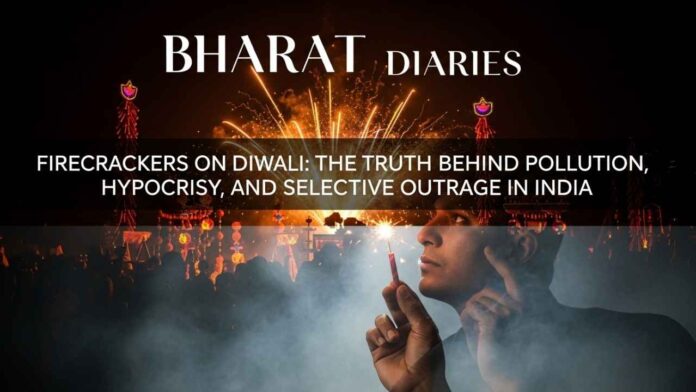
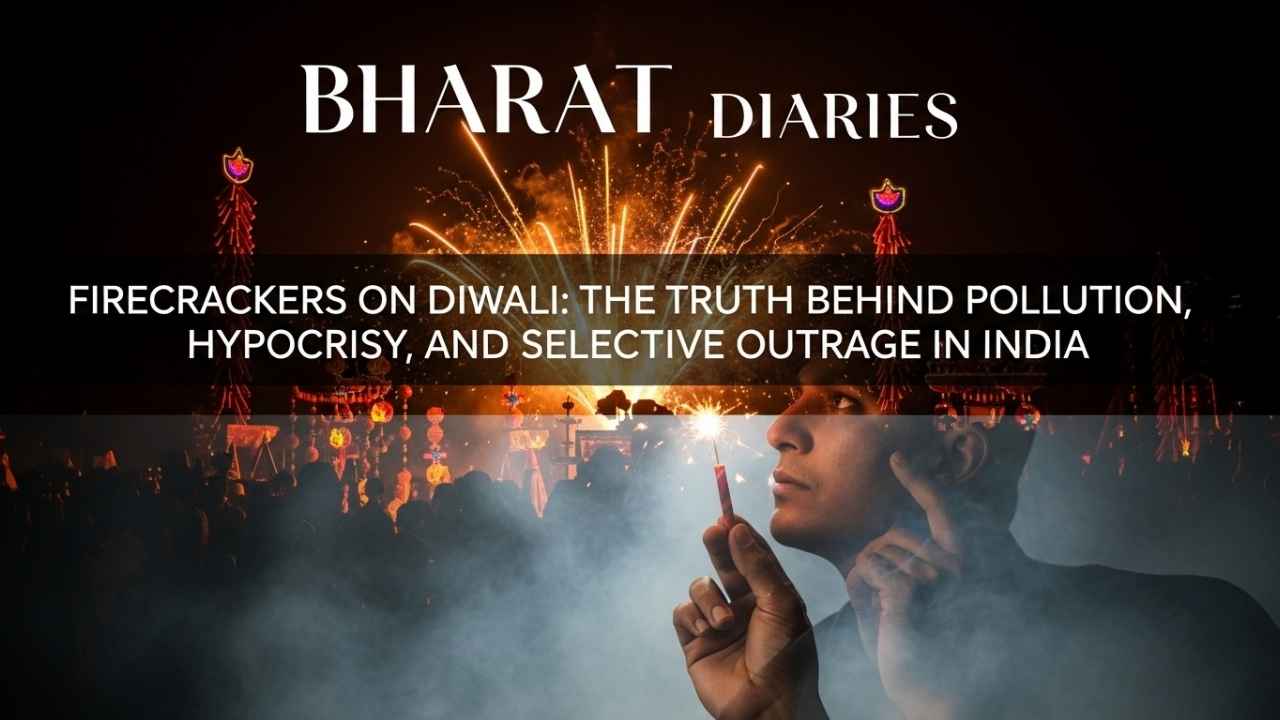
Why are firecrackers on Diwali targeted while pollution from ACs, cars, and parties is ignored? Explore the hypocrisy and truth behind this yearly debate.
Table of Contents
Every Diwali, as homes across India light up with diyas and joy, a familiar debate resurfaces — the “Firecrackers cause pollution” chorus. News anchors, celebrities, and self-proclaimed environmentalists begin their annual crusade, shaming Hindus for celebrating with crackers.
But the same people celebrate birthdays, weddings, Christmas, and New Year with loud fireworks, lavish parties, and luxury car processions — all without guilt.
This selective outrage and one-sided moral lecture raise a serious question:
Is the pollution concern real, or is it a mask for cultural hypocrisy?
Let’s dive deep into the truth behind this yearly controversy.
1. The Reality Behind Firecrackers and Pollution
Every Diwali, we hear one argument repeatedly — “Ban firecrackers, they pollute the air!”
Yes, crackers do contribute to pollution — but only for a very short period. According to various studies, the air quality worsens for a few days, but it’s nowhere close to the impact of vehicles, factories, and construction dust that operate year-round.
Real Polluters That Go Unnoticed
- Vehicles: India has over 35 crore registered vehicles, most of which run daily. Each emits harmful gases that choke cities like Delhi.
- Construction dust: Major cities generate tons of dust and debris every single day.
- Air conditioners: Every “environmentally conscious” person who lectures on Diwali pollution likely has multiple ACs running all night, even in winter.
- Industrial waste: Factories emit carbon and toxins throughout the year.
So why do we hear outrage only during Diwali?
Because it’s easier to target Hindu festivals than question real, powerful sources of pollution.
https://bharatdiaries.com/usa-shutdown-crisis-federal-layoffs-hit-hard/
2. The Hypocrisy: When Firecrackers Become “Sacred” for Others
Let’s be honest — firecrackers are not a Hindu monopoly.
We see fireworks bursting on New Year’s Eve, during weddings, cricket victories, Christmas celebrations, and even political rallies.
But strangely, no one objects then. No one says, “Don’t burst crackers, save the environment.”
No PILs, no news debates, no social media outrage.
The Selective Outrage
- Weddings: Crores of rupees are spent on fireworks for just one night. No one bats an eye.
- New Year’s Eve: Massive fireworks shows in Mumbai, Dubai, London — all celebrated globally.
- Christmas: Fireworks light up the sky, but no one calls it “polluting.”
- Eid or other religious events: Fireworks mark joy — but the environmentalists stay silent.
This silence isn’t accidental. It reflects a deeper social hypocrisy — fear of offending certain groups, while Hindu traditions are safe targets for lectures and bans.
3. AC Rooms and Car Convoys: The Double Standards of “Eco Warriors”
The biggest irony lies in who preaches the loudest.
Most people who lecture others on Diwali pollution:
- Live in air-conditioned apartments
- Drive luxury cars, often one per family member
- Attend lavish parties powered by generators and floodlights
- Use plastic decorations and imported gifts
They enjoy every comfort of modern life — all of which rely on fossil fuels and massive carbon emissions — yet feel entitled to guilt-trip others for bursting a few crackers once a year.
This isn’t environmental concern; it’s virtue signaling — showing off moral superiority while ignoring personal responsibility.
If the same energy was spent on reducing personal emissions, India’s air would be cleaner year-round.
4. The Cultural Essence of Firecrackers on Diwali
Before judging, let’s remember what Diwali truly represents.
It’s not just a festival of lights — it’s a celebration of the victory of good over evil, of joy, light, and prosperity.
Why Firecrackers Matter
- Symbol of Celebration: Fireworks represent the collective joy of millions of people welcoming Lord Ram after 14 years of exile.
- Tradition of Light: Crackers are seen as a way to dispel darkness and negativity.
- Family Bonding: Children and adults celebrate together, creating lifelong memories.
When we ban crackers or shame people for celebrating, we don’t just stop pollution — we extinguish joy, culture, and shared tradition.
As one old saying goes —
“A society that mocks its own festivals loses its soul.”
5. The Fear Factor: Why No One Dares to Speak Against Other Celebrations
Many Indians feel this double standard but hesitate to speak out. Why? Because they know the reality — criticizing non-Hindu celebrations invites trolling, backlash, or even threats.
So, people take the easy route — they show “activism” only on Hindu festivals.
This fear-driven silence has made our public discourse one-sided.
If one questions fireworks on Christmas or Eid, they’re labeled “intolerant.” But if they attack Diwali, they’re “progressive.”
The Dangerous Normalization of Bias
This repeated targeting conditions young Indians to subconsciously associate Hindu traditions with backwardness or pollution — while glorifying western or non-Hindu festivals as “modern” and “eco-friendly.”
It’s not just hypocrisy — it’s cultural conditioning.
6. Media’s Role in Fueling Selective Narratives
Media plays a massive role in shaping perceptions.
Each year, right before Diwali, headlines scream:
“Delhi chokes after Diwali!”
“Firecracker ban violated again!”
“Hindus continue to pollute the air!”
But where are the headlines when thousands of tonnes of waste are generated during weddings or New Year’s Eve? Where are the reports about factory emissions in Gurugram or vehicle smoke in Mumbai traffic?
The Pattern is Clear
The outrage cycle is seasonal — active only during Hindu festivals. It gives a moral high ground to certain “liberal” circles, keeping alive a false narrative that Hindu culture equals pollution.
That’s not journalism — that’s narrative engineering.
7. The Truth About Firecracker Industry and Employment
Another point often ignored is the livelihood factor.
The firecracker industry in India, especially in Sivakasi (Tamil Nadu), provides jobs to over 8 lakh people, including women.
When activists demand blanket bans without alternatives, it’s not just culture they attack — it’s the bread and butter of poor families.
A Balanced Approach is Possible
Instead of bans, the government and industries can:
- Promote eco-friendly firecrackers (green crackers)
- Set time limits for bursting
- Encourage proper waste disposal
This way, tradition continues and environment safety improves — a win-win solution.
8. Firecrackers and Faith: Why It’s More Than Just Noise
For millions of Hindus, Diwali crackers aren’t about noise — they’re about faith and emotion.
Bursting crackers after Lakshmi Puja symbolizes spreading light and energy across the atmosphere. It’s a spiritual expression, not just entertainment.
Understanding Before Judging
Critics often approach this from a purely environmental lens, ignoring the emotional connection.
But festivals aren’t meant to be sterile, silent events. They are living traditions that bind people together, reminding us of who we are.
When outsiders reduce Diwali to a pollution debate, they’re missing the essence — the celebration of light, love, and divine victory.
9. The Real Way Forward: Awareness, Not Bans
True environmental awareness doesn’t come from selective bans — it comes from balanced responsibility.
Instead of blaming one community’s festival, India needs to look at the full picture.
Steps That Actually Make Sense
- Encourage green crackers rather than complete bans.
- Limit firecracker timing (already implemented in many states).
- Promote cleaner energy for vehicles and industries.
- Raise awareness year-round, not just on Diwali.
- Lead by example — eco-warriors should start with reducing their own luxury-based emissions.
Sustainability should be collective, not selective.
10. Conclusion: Stop the Hypocrisy, Respect the Faith
Every year, the same people who burst crackers on weddings or New Year preach morality to Hindus during Diwali. This selective outrage exposes not concern for the environment, but deep-rooted hypocrisy and cultural bias.
Diwali is about light triumphing over darkness — and today, that darkness is not just pollution, but also misinformation and selective morality.
Instead of guilt-tripping a community, India needs honesty:
- Yes, let’s care for the environment.
- But let’s care equally, every day — not just when it’s Diwali.
Because real change begins when we stop hypocrisy and start balance.
Final Takeaway
The next time someone lectures you about “Firecrackers on Diwali”, ask them politely:
“Do you travel in AC cars? Do you celebrate New Year with fireworks? Do you use plastic gifts?”
If yes, then the problem isn’t Diwali — it’s double standards.
Celebrate responsibly, celebrate proudly — because Diwali belongs to light, not guilt.

