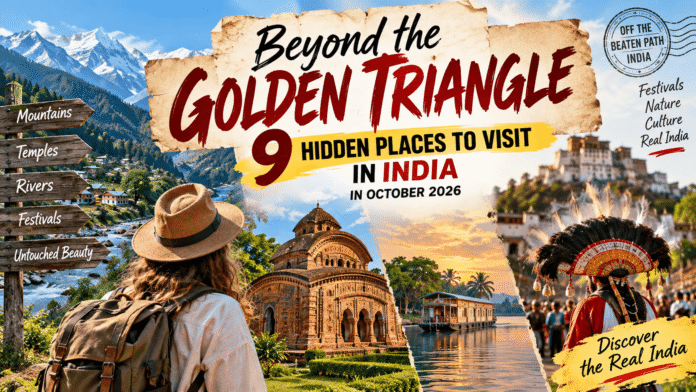
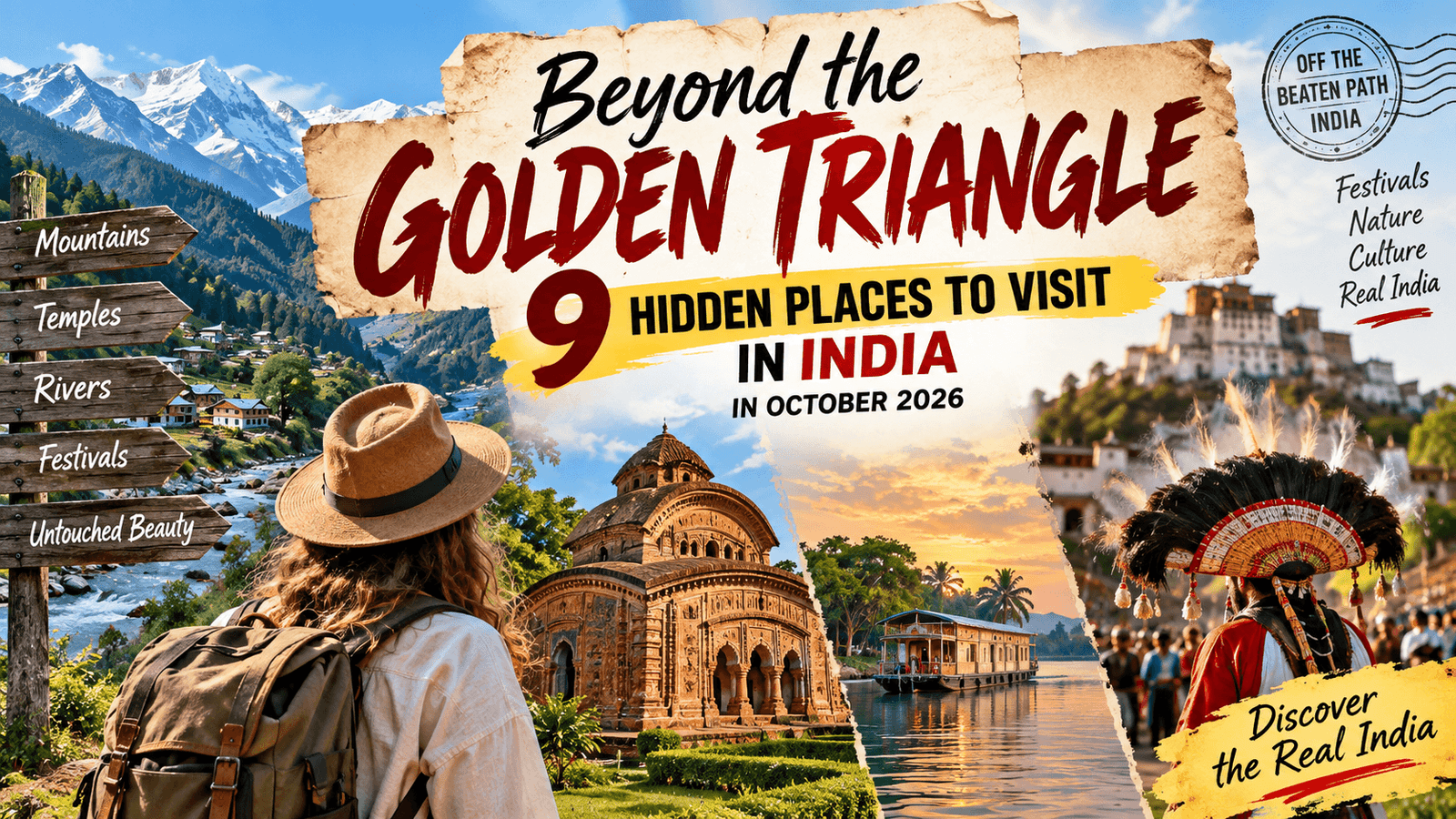
A practical, festival-timed guide for American and European travelers who want the India that most itineraries miss.
Table of Contents
Most first-time visitors to India follow the same well-worn loop: Delhi, Agra, Jaipur, maybe Varanasi or Kerala. It is a wonderful loop, and it is also crowded, hurried and very familiar from a thousand Instagram feeds. If you are reading this, you probably want something different: a fort you can wander at sunrise without a tour bus in sight, a village where the person pouring your tea is curious about where you are from, a festival that still belongs to the people who celebrate it.
October 2026 is an unusually good moment to go looking. The monsoon has retreated, the countryside is still green, the skies are clearing, and India’s biggest festival season is in full swing. Navratri runs from 11 to 19 October, Dussehra falls on Tuesday, 20 October, and Diwali follows on Sunday, 8 November. Between those dates, the country is at its most colorful, and some of the most rewarding celebrations are happening in places that never make the first page of a guidebook.
This guide covers nine of them, from Himalayan valleys to a river island in Assam, with honest notes on how to reach each one, what to expect in October, and how to fit them into a realistic trip.
Why October Is a Smart Month for Hidden India
Timing matters more in India than almost anywhere else, and October has a few quiet advantages.
The weather is turning your way. The southwest monsoon has withdrawn from most of the country by early October. The air is clearer, the hills are lush rather than parched, and the heat of the plains has not yet given way to the winter chill. In the Himalayas, October brings some of the crispest, most cloud-free mountain views of the year. In the Northeast, waterfalls are still running strong while the rain has eased.
The festival calendar is packed. Durga Puja peaks in Bengal from roughly 16 to 21 October, with Vijayadashami on the 20th. Garba dancing lights up Gujarat during Navratri. Dussehra fairs spread across Rajasthan and the Hindi belt. And in Himachal Pradesh, one of India’s most unusual festivals begins just as everyone else’s ends.
Tourist numbers are still lower than winter. The peak season for international visitors runs from November to February. October sits just before it, which means better hotel availability and quieter monuments, with one caveat: the festival weeks themselves are peak time for domestic tourists, so trains and popular hotels fill up early. Book ahead for any dates between 16 and 26 October.
One more note. “Hidden” is relative. None of the places below are unknown to Indians, and several are well loved by domestic travelers. But they are all places that the average American or European visitor is unlikely to reach on a first or second trip, and that is exactly what makes them worth your time.
1. Kullu Valley and Tirthan Valley, Himachal Pradesh: Where the Gods Come Down to Town
Most visitors to Himachal Pradesh head straight for Manali or Shimla. Look a little further and you will find the forested Tirthan Valley and, in the town of Kullu, a festival that stands apart from anything else in India.
Kullu Dussehra begins on Vijayadashami, the day that Dussehra celebrations end almost everywhere else, and runs for seven days. In 2026 the dates are expected to be 20 to 26 October (the district administration publishes the detailed programme closer to the date, so confirm before booking anything non-refundable). Instead of burning giant effigies on the first evening, Kullu does something far stranger and more beautiful. More than two hundred village deities, each carried on a decorated palanquin by the people of their own village, arrive at the Dhalpur Maidan to pay their respects to Lord Raghunath, whose chariot is pulled across the grounds by hand. Some of the deities have walked for days to get there. There are folk dances, a craft and food fair, and evening cultural programs. The festival ends with a procession to the banks of the Beas River.
It is loud, communal, and deeply local, and it gets far fewer international visitors than the scale of the event would suggest.
Where to stay. Kullu town gets extremely busy during the festival, so book two to three months ahead, or stay in Bhuntar near the airport, or in one of the smaller villages nearby, and commute in for the day.
Tirthan Valley makes a perfect counterpoint. About two hours’ drive from Kullu, it sits at the edge of the Great Himalayan National Park, a UNESCO World Heritage Site, and remains a place of wooden guesthouses, apple orchards, trout streams and forest walks rather than resorts. Nearby Jibhi and the Jalori Pass offer gentle hikes, including the walk to Serolsar Lake, and the tower temple at Chehni is a striking example of traditional Himalayan wood-and-stone architecture. October brings apple harvest, cool mornings and sharp blue skies.
Getting there. Fly from Delhi to Bhuntar airport (near Kullu), or take an overnight bus. By road, Delhi to Kullu is roughly 500 kilometers and about eleven hours. What to pack: layers. Evenings in the valley are cold in late October.
2. Bishnupur, West Bengal: Terracotta Temples and a Quieter Durga Puja
Kolkata’s Durga Puja is one of the great spectacles of the world, and if you can get there during the festival you should. But there is a second way to experience it: head to Bishnupur, about four to five hours from Kolkata, where the celebrations are smaller, older and more intimate.
Bishnupur was the capital of the Malla kings, who ruled this part of Bengal for centuries and left behind a remarkable collection of brick and terracotta temples dating mainly from the 17th and 18th centuries. The Rasmancha, a pyramid-roofed brick structure from around 1600, is the most distinctive. The Shyam Rai and Jor Bangla temples are covered in finely molded terracotta panels showing scenes from the Ramayana, Mahabharata and Krishna legends, as well as everyday life in the old kingdom. Nothing else in India looks quite like them.
The town is also a craft center. Bishnupur is known for Baluchari silk sarees woven with mythological scenes, for dokra metal casting, and for the terracotta Bankura horse that has become a symbol of Bengali folk art. It has its own musical tradition too, the Bishnupur gharana of classical music. Wander the workshop lanes in the afternoon and you will find artisans happy to show you their process.
During Durga Puja (roughly 16 to 21 October, with Vijayadashami on the 20th), the town’s old temples and neighborhood pandals come alive. Expect drumming, incense, families dressed in their best, and a warmth toward visitors that is hard to find in Kolkata’s crowded pandal circuit. Keep in mind that banks and many shops close for several days during the festival, so carry enough cash.
Getting there. Trains run from Kolkata to Bishnupur in around four hours, and hired cars are easy to arrange. Most travelers stay one or two nights.
3. Majuli, Assam: A River Island of Monasteries
Majuli, in the middle of the Brahmaputra River, is often described as the largest river island in the world. It is also one of the most peaceful and culturally distinctive places in India.
The island is the heart of Assam’s Neo-Vaishnavite tradition, founded by the 15th-century saint-reformer Srimanta Sankardeva. Its sattras, or monasteries, are living institutions where monks practice devotional music, dance and drama, and where craftsmen make elaborate masks used in traditional theater. Samaguri Sattra is especially known for its mask-making, and you can watch the work being done. Kamalabari Sattra is a center of dance and music. Beyond the monasteries, Majuli is home to the Mishing people, who live in bamboo stilt houses and weave beautiful textiles on backstrap looms.
The island is a place to slow down. Rent a bicycle or a scooter, follow the dirt lanes past rice paddies and wetlands, and stop wherever something catches your eye. October is a good time to visit: the floods have receded, the fields are green, and migratory birds are beginning to arrive.
Be aware that Majuli is shrinking because of river erosion, and the island has lost a significant amount of land over the past century. Traveling responsibly here, staying in locally owned homestays and buying directly from artisans, is one of the more meaningful ways to support the community.
Getting there. Fly to Jorhat, then travel to Nimati Ghat and take the ferry across to Majuli, which takes roughly an hour or more depending on river conditions. Ferries can be crowded and schedules can shift, so build in flexibility. Kaziranga National Park, famous for its one-horned rhinoceros, typically reopens to visitors around November, so it is best as an add-on for later in the season rather than an October stop.
4. Khasi Hills, Meghalaya: Living Root Bridges and Sacred Forests
Meghalaya means “the abode of clouds,” and after the monsoon retreats, the clouds part to reveal one of the most spectacular landscapes in the country. The Khasi and Jaintia Hills are best known for the living root bridges: aerial walkways grown over generations from the roots of rubber fig trees, guided across streams by Khasi villagers over decades or even centuries.
The most famous is the double-decker root bridge at Nongriat, reached by a steep walk down roughly three thousand stone steps from the trailhead at Tyrna. It is a real effort, and you will feel it in your knees the next morning, but the jungle pools and the bridges at the bottom are worth every step. Plan to stay the night at a village homestay so you can enjoy it without the day-trip crowds.
Other places worth including:
- Mawphlang Sacred Forest, about 25 kilometers from Shillong, a protected grove that local communities have preserved for centuries as the abode of a forest deity. Guided walks explain the customs that surround it.
- Dawki and the Umngot River, whose water is so clear that boats appear to float on air. The river marks the border with Bangladesh.
- Shnongpdeng, a small village downstream where you can swim, snorkel and camp along the riverbank.
- Mawlynnong and nearby villages, often promoted as among the cleanest in Asia, offering another look at Khasi village life.
October usually brings clearer skies and full waterfalls, making it one of the better months for the region. Rain is still possible, so bring a light waterproof layer and shoes with good grip.
Getting there. Fly to Guwahati, then take a shared taxi or private car to Shillong, about three hours away. Shillong is a good base for the first days.
5. Mandu and Maheshwar, Madhya Pradesh: Ruined Palaces Above the Clouds
Madhya Pradesh is one of the least-visited major states for international travelers, which is a shame, because it holds some of the finest architecture in India. Mandu is the place to begin.
Perched on a plateau of the Vindhya range, Mandu was a fortified capital of the Sultans of Malwa in the 15th century. Its Afghan-influenced architecture is elegant and understated: the long, arched Jahaz Mahal, or Ship Palace, built between two lakes; the Hindola Mahal with its sloping walls; the domed marble tomb of Hoshang Shah, often cited as an inspiration for later Mughal masterpieces. Walk out to the ruined pavilions of Rani Roopmati and Baz Bahadur at the edge of the plateau and you get sweeping views across the valley below.
October is the best time to see Mandu. After the monsoon, the whole plateau turns green, lakes fill up, and the mist that clings to the ruins in the early morning is magical. Later in the year the landscape dries out, and in summer it is very hot. Look out for the enormous baobab trees, a curiosity brought centuries ago from Africa, growing beside the monuments.
About 90 kilometers away, on the banks of the Narmada River, is Maheshwar. The town is centered on a grand fort and a series of stone ghats built in the 18th century by the Maratha queen Ahilyabai Holkar, one of the most admired rulers in Indian history. The riverside temples at sunset, with pilgrims lighting lamps on the water, are beautiful. Maheshwar is also famous for its handwoven Maheshwari sarees; several local weaving cooperatives welcome visitors, and it is a good place to buy fabric directly from the makers.
Getting there. Fly into Indore, the state’s largest city and a great stop in its own right for its street food, particularly the Sarafa night market. Mandu and Maheshwar are each a few hours’ drive from there, and can be covered in a two- or three-night loop.
6. Orchha, Madhya Pradesh: A Medieval Town on the Betwa River
If you have already seen Rajasthan’s palaces and want somewhere calmer, Orchha is a rewarding surprise. Founded in the 16th century by the Bundela Rajputs, it sits on a bend of the Betwa River, and much of the old town has changed little since. The palaces here are not polished museums. They are large, atmospheric, slightly crumbling buildings that you can climb through, explore alone, and photograph without crowds.
The Raja Mahal and Jahangir Mahal are the main palace complexes, with courtyards, balconies and chambers that still carry traces of old wall paintings. The Chaturbhuj Temple rises above the town in a tall, complicated silhouette. A row of domed royal cenotaphs, or chhatris, stands on the riverbank and glows in late afternoon light; walk across the old bridge at sunset and you will see why photographers love this town.
Uniquely, Orchha’s Ram Raja Temple is a working temple where Lord Rama is worshipped as a king, and is guarded by armed police in ceremonial fashion. The evening aarti here is lively, sincere and open to respectful visitors.
Orchha works well as a two-night stop. It is close to Jhansi, which has direct rail links to Delhi, and it pairs naturally with Khajuraho’s temples, roughly three to four hours away by road. October daytime temperatures are still warm, so plan sightseeing for mornings and late afternoons.
7. Bundi, Rajasthan: The Blue-Washed Rajput Town Nobody Talks About
Rajasthan is the classic India of postcards, but most visitors never make it to Bundi. That is their loss.
Tucked beneath the Aravalli hills, Bundi has a fort-palace complex that clings to the hillside above a cluster of old town houses. Bundi Palace is famous for the Chitrasala, a painted gallery whose walls and ceilings are covered in exquisite Rajput miniature-style murals in blues and greens. Rudyard Kipling was so impressed by the palace that he wrote about it. Higher up, the Taragarh Fort offers sweeping views and a quiet climb, with the occasional monkey for company.
Down in the town, the real reward is simply wandering. Bundi has dozens of stepwells and baoris, including the beautiful, deep Raniji ki Baori from the late 17th century. Lanes of blue-and-white houses lead to tiny temples, chai stalls and a lake, Nawal Sagar, with a partly submerged temple. The pace is unhurried, and the local guesthouses, many of them in restored havelis, are warm and affordable.
Bundi has a bonus in October. Just 35 kilometers away is Kota, whose annual Dussehra fair is one of the largest in Rajasthan, with cultural events, giant effigies and a carnival atmosphere. You can base yourself in Bundi and take a day trip to see it.
Getting there. Kota is the nearest major railhead, about five hours from Delhi by fast train, and a taxi from there takes under an hour. Bundi is also roughly four hours by road from Jaipur. Days in early October can still be hot, so start early and plan a long lunch break.
8. Champaner-Pavagadh and Vadodara, Gujarat: Garba Nights and a Forgotten UNESCO City
Gujarat is not usually high on foreign visitors’ lists, but during Navratri (11 to 19 October 2026) it becomes one of the most exciting places in the world. Across the state, thousands of people gather each night to dance the garba, moving in concentric circles around a lamp or an image of the goddess in colorful embroidered clothes. Vadodara (Baroda) is known as one of the best cities to experience it.
Many of the largest garba grounds are ticketed and can get very crowded, but smaller neighborhood events are often easier to join, and Gujaratis are famously generous hosts. Dress modestly and comfortably, be prepared to stay up late (things often start around 9 or 10 in the evening and run until midnight or beyond), and do not be surprised if a friendly stranger pulls you into the circle.
By day, visit Champaner-Pavagadh Archaeological Park, about 45 kilometers from Vadodara. Inscribed as a UNESCO World Heritage Site in 2004, it preserves a medieval Islamic city set among older Hindu and Jain remains, with beautifully carved mosques, gateways and step wells that are almost always nearly empty. Above it rises Pavagadh Hill, crowned by the Kalika Mata temple, which you can reach by ropeway or on foot. Back in Vadodara, the opulent Laxmi Vilas Palace, often described as larger than Buckingham Palace, is worth a visit.
A practical note. Gujarat is a “dry” state with alcohol restrictions, though visitors can usually apply for a temporary permit. Check current rules with your hotel before you travel.
9. Binsar, Jageshwar and Kumaon, Uttarakhand: Himalayan Views Without the Crowds
If Kullu is about culture, Kumaon is about quiet. This region of Uttarakhand, on the edge of the high Himalaya, is a landscape of pine and deodar forests, terraced villages and stone temples, with a very long mountain view.
Binsar, a wildlife sanctuary at roughly 2,400 meters, has a viewpoint that on a clear October morning offers a panorama of the great Himalayan peaks, including Nanda Devi, Trishul and the five summits of Panchachuli. October is among the best months for these views: the air is clean, the sky is clear, and the summer haze is gone. Oak and rhododendron forest walks around the sanctuary are gentle and quiet.
Jageshwar, near Almora, is a cluster of over a hundred small stone temples in a deodar forest beside a stream, some dating back more than a thousand years. It is a serene place, still used for daily worship, with no crowds and no entrance-fee bustle. Nearby, Almora offers a lively market, local copper crafts and the region’s famous bal mithai, a fudge-like sweet.
Farther afield, small hill villages such as Kausani, Mukteshwar and Munsiyari offer more mountain scenery, and there are good homestays throughout the region.
Getting there. The nearest train station is Kathgodam, reached from Delhi by rail, and from there it is about a four-hour drive to Almora. Roads in the hills are winding, so allow plenty of time and consider hiring a driver.
Planning Your Trip: The Essentials
Visas
Citizens of the United States and most European countries can apply for an India e-Tourist Visa online through the official government portal, indianvisaonline.gov.in. As of 2026, the 30-day visa costs about US$25 for most nationalities (with a reduced rate in April to June), the one-year visa around US$40, and there is a small bank charge on top. Fees can vary by nationality, so check the schedule for your passport. Apply at least four days before arrival, and ideally two weeks or more. Your passport should be valid for at least six months from your arrival date, with blank pages for stamps. Note that the e-Visa is generally non-extendable and is valid only at designated airports and seaports, not at land borders. Beware of lookalike websites that charge several times the official fee.
Health and Safety
See a travel clinic four to six weeks before you leave. Common recommendations include hepatitis A, typhoid and routine vaccinations; ask about malaria prevention if you plan to visit forested areas in the Northeast or central India. October is the tail end of mosquito season in many regions, so bring insect repellent. Drink bottled or filtered water, be thoughtful about street food (choose busy stalls where food is cooked fresh), and buy comprehensive travel insurance that covers medical evacuation.
Money and Connectivity
Carry some cash, especially in smaller towns and during festival closures, since ATMs can run empty and banks close during Durga Puja. An eSIM or local SIM card is inexpensive and useful for maps and ride-hailing. Book trains through the official Indian Railways channels well ahead of time, and consider domestic flights for long distances.
Respectful Travel
Dress modestly at temples and religious sites, and remove your shoes where required. Ask before photographing people, especially during rituals. Buy crafts directly from artisans, choose locally owned stays where you can, and avoid single-use plastic in fragile places like the hills and river islands.
Three Sample Itineraries
The Festival Himalayas (8 to 10 days). Fly Delhi to Bhuntar, spend three nights in the Tirthan Valley, then move to Kullu for the opening days of Dussehra (from 20 October). Finish with a night or two in Delhi before flying home.
The Heartland Heritage Loop (9 to 11 days). Fly into Indore for two nights, drive to Maheshwar and Mandu for three, then take the train to Jhansi and continue to Orchha and Khajuraho for the rest of the trip. This works well in early to mid October.
The Northeast and Bengal Escape (10 to 12 days). Fly into Guwahati, continue to Shillong and the Khasi Hills for four nights, fly on to Jorhat and cross to Majuli, then travel to Kolkata and Bishnupur to catch the final days of Durga Puja around 16 to 21 October.
For a first trip to India, do not try to combine all nine destinations. Choose one region, leave gaps in your schedule, and accept that trains and roads will occasionally take longer than planned. The reward for going slowly is that you will actually see the place you came for.
Final Thoughts
The India that most travelers see is astonishing, but it is only one version of the country. In October 2026, you can watch two hundred village gods arrive in a Himalayan town, dance garba with strangers in Gujarat, wander an empty stepwell in Rajasthan, or drift across the Brahmaputra to an island of monks and mask-makers. These are places where a visitor is still an event, where a conversation is still more likely than a sales pitch, and where the festival season feels like it belongs to the people celebrating it.
Go with curiosity, go slowly, and leave room for the unexpected. That is where India tends to show you its best side.
Festival dates are based on published calendars at the time of writing and can vary by a day depending on region and local almanac. Confirm dates, permits, visa fees and travel conditions with official sources before you book.

