Table of Contents
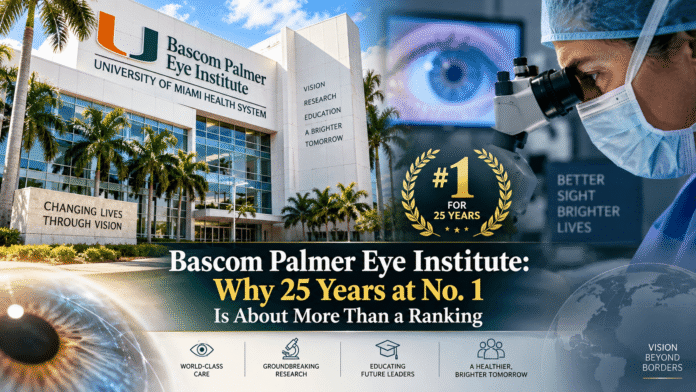
For the 25th time, Bascom Palmer Eye Institute has been named the best ophthalmology program in the United States by U.S. News & World Report. It’s the kind of headline that could easily be filed away as just another award for the trophy case. But a closer look at how Bascom Palmer has sustained this level of recognition since 1990 — through more than three decades of scientific upheaval in medicine — tells a more interesting story. It’s a story about what happens when patient care, research, and education aren’t treated as three separate departments, but as three gears in the same machine.
This piece digs into what the ranking actually reflects, the conditions Bascom Palmer specializes in treating, the technologies reshaping the field, and where the institute believes eye care is headed next.
Bascom Palmer Eye Institute: A Quarter-Century of No. 1 Rankings
U.S. News & World Report has surveyed U.S. physicians for its annual “Best Hospitals” rankings since 1990, and Bascom Palmer has now claimed the top spot in ophthalmology 25 separate times in that period — most recently for 2026–2027. The rankings aren’t based on marketing or self-reported success stories. They draw on data from thousands of medical centers nationwide and survey responses from tens of thousands of physicians, who are effectively asked where they would send their own patients for the most complex, high-stakes eye conditions.
That detail matters. A ranking built on peer physician judgment, rather than patient satisfaction surveys or volume statistics alone, tends to reward institutions that specialize in the hardest cases — the diagnoses that get referred onward when a general ophthalmologist or even a subspecialist elsewhere has run out of options. Being the destination for those referrals, year after year, for 25 separate ranking cycles, suggests something structural rather than incidental about how the institute operates.
Founded in 1962, Bascom Palmer has grown from a single specialty hospital into a Department of Ophthalmology within the University of Miami’s Miller School of Medicine, now caring for several hundred thousand patients annually across multiple centers in Florida. Institute leadership has also pointed to plans for the organization’s first expansion outside the United States, with a facility planned in Abu Dhabi — a sign that the institute’s model of care is being viewed as exportable, not just locally excellent.
Three Pillars, Not One Achievement
Ask the people who run Bascom Palmer what actually explains the ranking, and the answer isn’t “great doctors” alone. It’s a combination of three things that reinforce each other: patient care, vision research, and medical education.
This three-pillar framing is worth taking seriously rather than treating as boilerplate mission-statement language, because it explains a lot about how academic medical centers differ from other kinds of specialty clinics. A purely clinical practice, however skilled, treats the conditions that walk through the door using the tools available today. A purely research-focused lab develops new science but doesn’t necessarily translate it into bedside practice on any predictable timeline. What distinguishes an institution like Bascom Palmer is the attempt to close that loop — using clinical experience to shape research questions, and using research findings to change what happens in the exam room, often faster than would occur if the two functions were housed separately.
Medical education is the third leg of that stool, and it’s easy to underrate its importance. Training the next generation of ophthalmologists and subspecialists is how a single institution’s approach to care propagates outward into hospitals and clinics across the country. A resident or fellow who trains at a place with a strong pipeline between research and clinical practice tends to carry that instinct with them into their own future practice, whether or not they ever set foot in Miami again professionally.
The Conditions: Where Complexity Concentrates
Bascom Palmer’s reputation rests heavily on its willingness and ability to take on the eye conditions that are hardest to diagnose and treat. These include:
Glaucoma. Often called the “silent thief of sight” because it can progress with few noticeable symptoms until significant vision loss has already occurred, glaucoma remains one of the leading causes of irreversible blindness worldwide. It’s also one of the areas where Bascom Palmer’s research ambitions are most visible, which we’ll return to below.
Retinal diseases. Conditions affecting the retina — the light-sensitive tissue at the back of the eye — range from age-related macular degeneration to diabetic retinopathy to rarer inherited retinal disorders. These diseases are often where the newest generation of gene therapies and advanced imaging technologies is being tested first, because the retina is relatively accessible for both observation and targeted treatment compared to other parts of the eye.
Corneal diseases. The cornea’s clarity and shape are essential to vision, and corneal disease — whether from infection, injury, degeneration, or genetic conditions like keratoconus — can be treated with everything from specialty contact lenses to corneal transplantation, depending on severity.
Pediatric eye conditions. Children’s eyes present unique diagnostic and treatment challenges, since a young, developing visual system responds differently to disease and intervention than an adult’s, and misdiagnosis or delayed treatment can affect a child’s vision for the rest of their life.
Neuro-ophthalmology. This subspecialty sits at the intersection of ophthalmology and neurology, addressing vision problems that stem from conditions affecting the brain, optic nerve, or nerves controlling eye movement — often requiring collaboration across multiple medical disciplines to properly diagnose.
Ocular cancers. Tumors of the eye and surrounding structures are rare enough that few ophthalmologists anywhere accumulate deep experience treating them, which makes concentrated expertise at high-volume centers especially valuable for patient outcomes.
Ophthalmic plastic and reconstructive conditions. This includes surgical treatment of the eyelids, tear ducts, and the bony orbit surrounding the eye — conditions that sit at the boundary between vision preservation and reconstructive/cosmetic surgery.
Treating this full spectrum of conditions under one roof, with subspecialists deeply experienced in each, is part of what allows Bascom Palmer to serve as a referral destination when other providers reach the limits of what they can diagnose or treat.
Where Technology Is Changing the Exam Room
If there’s a common thread running through recent advances at institutions like Bascom Palmer, it’s the convergence of several previously separate fields: medical imaging, genetics, artificial intelligence, and data science. Individually, none of these is new to medicine. Together, they’re beginning to change what “early diagnosis” and “personalized treatment” actually mean in ophthalmology.
Artificial intelligence and glaucoma prediction. One of the more consequential applications of AI in ophthalmology right now is in predicting who is likely to develop glaucoma in the first place, and — for patients already diagnosed — how quickly their disease is likely to progress. This matters enormously in a condition where treatment success is closely tied to how early it starts. A patient identified as high-risk years before symptoms would otherwise prompt a diagnosis can begin monitoring or preventive treatment while there’s still healthy tissue and vision to protect. Historically, glaucoma progression has been difficult to predict on an individual level, because the disease advances at wildly different rates in different patients even when their initial presentation looks similar. Machine learning models trained on large datasets of imaging and clinical outcomes are beginning to change that, picking up on subtle patterns in optic nerve imaging that may not be obvious to the human eye reviewing a single scan.
Imaging advances. Modern retinal and optic nerve imaging technologies allow clinicians to detect structural changes in the eye well before those changes produce noticeable vision loss. This is a meaningful shift from a diagnostic model that historically relied heavily on functional testing (like visual field tests) that can only detect damage after a substantial amount of tissue has already been affected.
Genetics and biomarkers. As genetic testing becomes more accessible and affordable, researchers are increasingly able to identify which patients carry a heightened genetic risk for certain eye diseases — information that can inform both screening schedules and, eventually, treatment choices tailored to a person’s specific biological risk profile rather than a one-size-fits-all protocol.
Gene therapy and cellular therapy. Some of the most ambitious research underway targets the root biological causes of vision loss rather than just managing symptoms. Gene therapies aim to correct or compensate for defective genes responsible for inherited eye diseases, while cellular therapies explore replacing or repairing damaged retinal cells. These approaches remain in earlier stages for many conditions, but they represent a genuinely different treatment paradigm than the pharmaceutical and surgical approaches that have dominated ophthalmology for decades.
Drug-delivery systems. Getting medication to precisely the right part of the eye, at the right concentration, for the right duration, is a persistent challenge in ophthalmology — eye drops, for instance, are notoriously inefficient, with much of the medication draining away before it can be absorbed. New drug-delivery technologies, including sustained-release implants and more targeted injection techniques, are aimed at improving how consistently patients receive their prescribed treatment and reducing the burden of frequent dosing.
Advanced surgical technique. Surgical innovation continues alongside all of these non-surgical advances, with techniques for cataract surgery, retinal surgery, and corneal transplantation continuing to become less invasive and more precise.
Bringing Care Into the Home
Not every advance in eye care is about high-tech diagnostics or novel therapeutics. Some of it is about logistics — making it easier and safer for patients to manage chronic eye conditions in their day-to-day lives, especially between clinical visits.
Telemedicine and digital testing tools are increasingly allowing certain aspects of eye care to move out of the clinic and into the patient’s home. For conditions that require frequent monitoring, like glaucoma, this can mean the difference between catching a meaningful change in a patient’s condition promptly versus waiting months for the next scheduled appointment.
One especially practical example: research into glaucoma care found that improving home lighting reduced patients’ risk of falls and improved their overall safety. It’s a reminder that vision loss isn’t just a clinical measurement — it’s something that reshapes how a person moves through their own home, and addressing that reality is as much a part of eye care as managing intraocular pressure. Simple environmental interventions like better lighting design can meaningfully reduce the everyday risks that come with declining vision, particularly for older adults who are already at elevated fall risk for other reasons.
Why the Research-to-Clinic Pipeline Matters for Patients
None of the technological advances described above matter much to an individual patient unless they can actually access them. This is where the connection between research and clinical care becomes tangible rather than abstract.
Patients treated at institutions with active, well-funded research programs often gain access to things that wouldn’t otherwise be available to them: enrollment in clinical trials testing emerging treatments before they receive full regulatory approval, diagnostic technologies that haven’t yet become standard equipment at every eye clinic, and physicians who are directly involved in developing the next generation of treatments for the very condition the patient has. For a patient facing a rare or particularly aggressive eye disease, being treated somewhere with an active research pipeline in that exact area can mean the difference between standard-of-care management and access to something genuinely new.
This is also, in a sense, the underlying logic of why physician-driven rankings tend to concentrate around academic medical centers with strong research programs. Physicians know which institutions are producing the research that changes clinical guidelines, and they know which centers their most difficult cases tend to get referred to. A ranking built on that kind of professional consensus is, in effect, measuring accumulated trust built through decades of both scientific output and clinical outcomes.
What’s Next: Multiomics and the Expanding Role of AI
Looking ahead, Bascom Palmer’s leadership has pointed to multiomics as a particularly important direction for the future of glaucoma research. Multiomics refers to the integration of multiple types of biological data — genetic information, broader biological markers, and environmental factors — into a single, more complete picture of an individual patient’s disease risk and progression.
The appeal of this approach is that no single data type tells the whole story on its own. Genetics alone doesn’t fully explain why some people develop glaucoma and others don’t, or why the disease progresses quickly in some patients and slowly in others. Environmental and lifestyle factors interact with genetic predisposition in ways that are only now becoming measurable at scale. By combining these different layers of information, researchers hope to build far more precise models of individual risk than any single data source could provide — potentially allowing treatment plans to be tailored not just to a diagnosis, but to the specific combination of factors driving that particular patient’s disease.
Artificial intelligence is expected to play an increasingly central role across this entire effort, not just in glaucoma but in diagnosing and treating blinding eye diseases more broadly. As imaging technology generates ever-larger volumes of high-resolution data, and as genetic and biomarker datasets continue to grow, AI-driven analysis becomes less of a novelty and more of a necessity — a way of finding patterns in complexity that would otherwise be invisible to even the most experienced clinician working through data manually.
What This Means If You’re Choosing an Eye Care Provider
For most people, a national ranking like this one isn’t directly actionable — the majority of eye care needs, from routine vision correction to standard cataract surgery, are handled perfectly well by local ophthalmologists and optometrists, and there’s no need to travel across the country for a comprehensive eye exam. Where rankings like this become genuinely relevant is at the point where a diagnosis becomes complicated, rare, or resistant to standard treatment.
That’s the moment when it’s worth asking a treating physician whether a referral to a specialized center makes sense — not because local care is inadequate, but because certain conditions benefit disproportionately from being managed by teams that see a high volume of similarly complex cases. A rare inherited retinal disease, an aggressive ocular tumor, or a case of glaucoma that isn’t responding to standard treatment are all examples of situations where the accumulated experience of a specialized center can change the trajectory of a patient’s care. Academic medical centers with strong research programs also tend to be the ones running clinical trials, which matters for patients who’ve exhausted approved treatment options and are looking for access to therapies still in development.
It’s also worth noting that the value of an institution like Bascom Palmer isn’t limited to the patients who are physically treated there. Because academic medical centers train large numbers of ophthalmology residents and fellows, the clinical practices and diagnostic instincts developed at these institutions spread outward as those trainees go on to practice elsewhere. A patient being seen by an ophthalmologist who trained at a leading academic center may benefit indirectly from that training, even if they never set foot in the center itself.
A Note on How These Rankings Work
It’s worth spending a moment on the mechanics of the U.S. News & World Report rankings, since understanding the methodology helps explain why the result carries weight within the medical community rather than being dismissed as just another “best of” list. The rankings draw on data from thousands of medical centers nationwide, combined with reputational survey responses from tens of thousands of licensed physicians across relevant specialties. Physicians are asked, in effect, where they would refer patients with the most difficult, complex cases in a given specialty — a question that tends to surface institutions known for handling situations other providers can’t.
This reputational component is part of why the same handful of academic medical centers tend to recur at the top of specialty rankings year after year. Reputation among physicians isn’t built overnight, and it isn’t easily gamed by marketing; it accumulates slowly, based on outcomes, referral patterns, published research, and the caliber of trainees a program produces. A ranking sustained across 25 separate survey cycles, spanning more than three decades of medical practice, reflects a level of consistency that’s difficult to achieve through any single strong year or a few standout physicians. It requires an entire institutional culture — spanning clinical departments, research labs, and training programs — that continues to perform at a high level even as individual leaders and faculty members move on, retire, or hand off their roles to the next generation.
The Bigger Picture
It would be easy to read a headline like “ranked No. 1 for the 25th time” and move on without much further thought. But the more interesting story is what sustaining that position for over three decades actually requires: a continuous, deliberate effort to keep patient care, research, and education tightly linked, even as the underlying science of ophthalmology has been transformed multiple times over — from the era before modern retinal imaging, through the rise of anti-VEGF injections for macular degeneration, and now into an era shaped by AI-assisted diagnostics and genomic medicine.
The ultimate measure of any of this isn’t the ranking itself, but what it enables: earlier diagnosis for patients who might otherwise lose vision before symptoms ever prompted them to see a doctor, more personalized treatment based on an individual’s actual biological risk rather than population averages, and continued access to emerging therapies for patients facing conditions that, until recently, had few good options. A ranking is a signal that an institution is trusted by its peers. What that trust is actually built on — the research, the training, the accumulated clinical experience with rare and difficult cases — is where the real value to patients lives.

